
My sweet son, Ryder, started developing red splotches all over his body one day while we were enjoying some family time at a festival in the hot Florida sun. My husband and I quickly snapped some pictures and sent them to a friend who is a Pediatric Nurse Practitioner, who told us it looked like eczema. He was only 3 months old at the time, and we had no idea what was in store for us in the coming months.
During those first few weeks, Ryder’s skin condition waxed and waned. His skin would be perfectly fine, and then the next minute he would be covered in red patches all over his body. At first, it didn’t seem to bother him much, so we didn’t take immediate action.
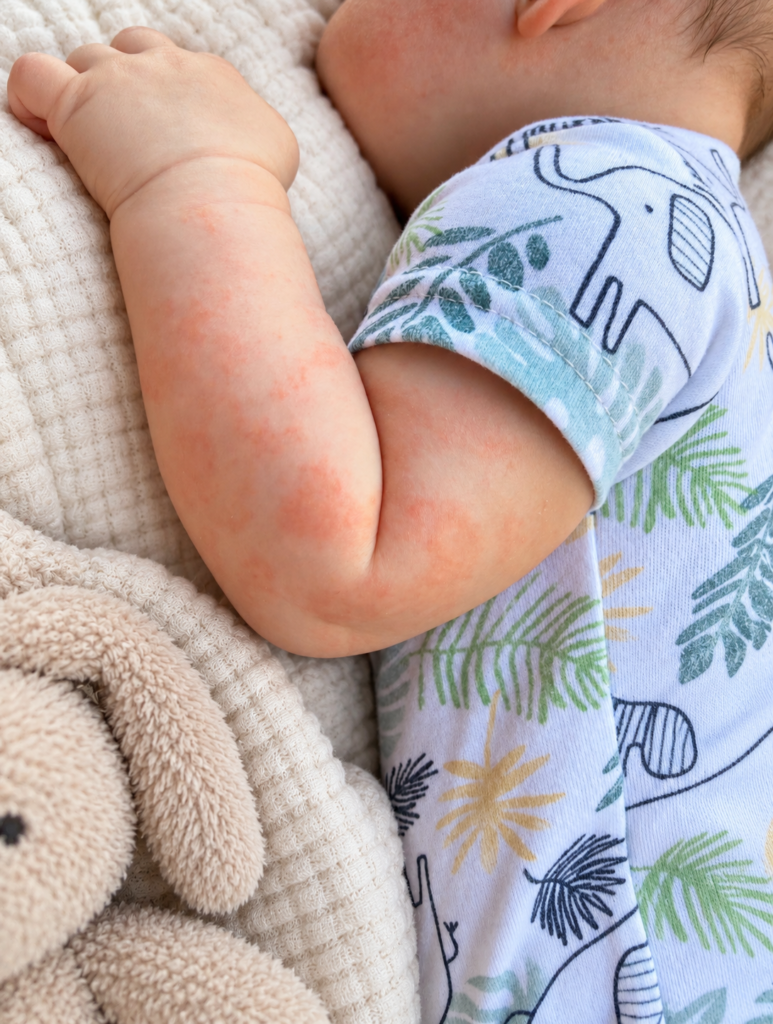
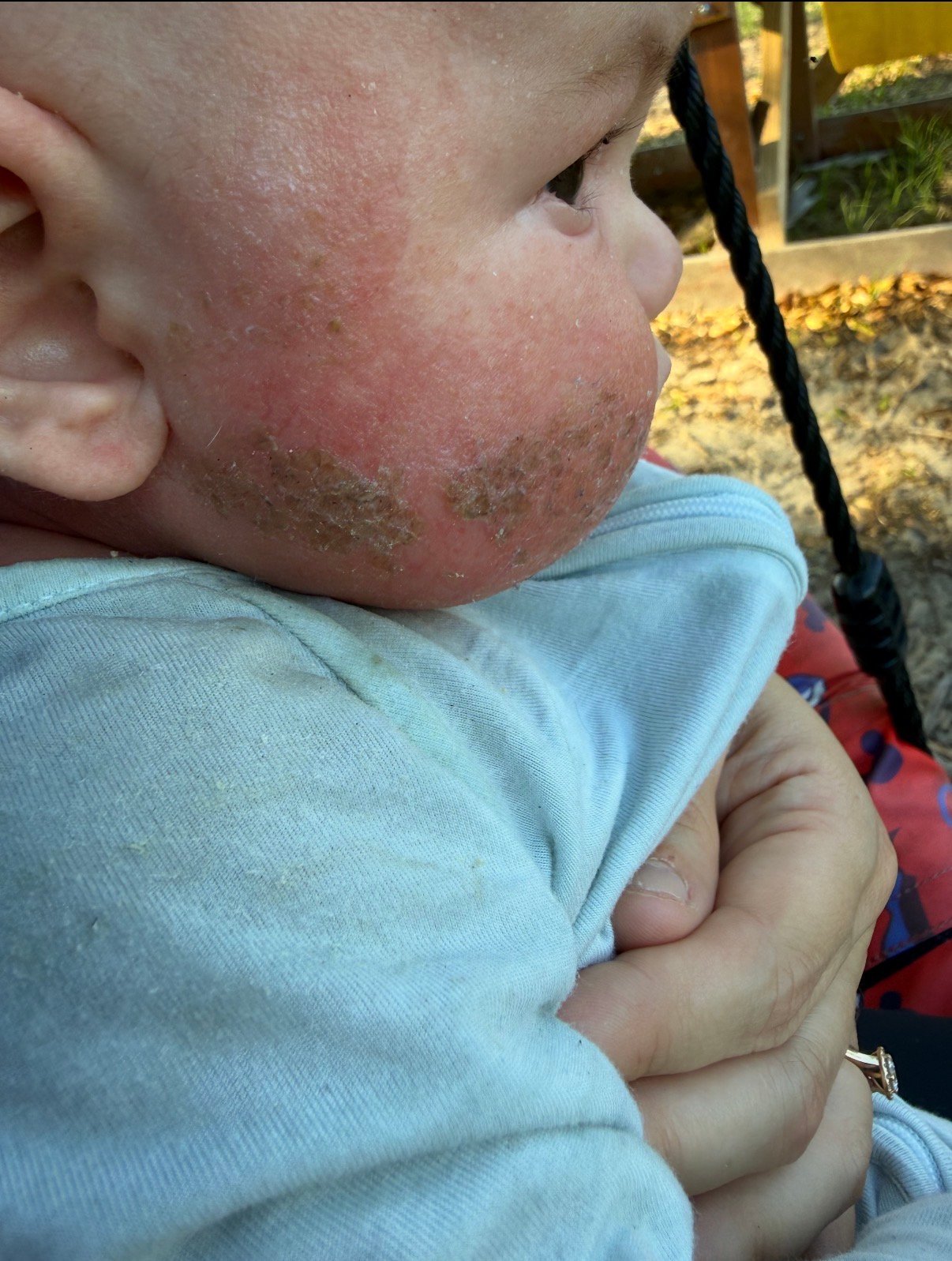
Over the course of a few weeks, things started to worsen. His skin became more red and inflamed. Areas became open and raw, and the eczema became more widespread.
We sought medical attention from his pediatrician, but the initial diagnosis and treatment recommendation didn’t sit right with me. Thankfully, being a nurse, I was apprehensive about putting the medication they recommended on my son’s open, weeping, raw skin.
During this time, I continuously searched the internet for any cream, ointment, lotion, soap—anything I could get my hands on in hopes of helping his poor skin and giving my baby some relief from the dryness, cracking, itching, and discomfort.
A few days later, I reached back out to his pediatrician and requested a referral to a local dermatologist. Thankfully, we were able to get an appointment relatively quickly.
To no surprise, we were prescribed topical steroids—a stronger one for his body to use for only a few days and then a lower-strength one that we could also use on his face.
To my surprise, his skin started improving within just a few applications.
But as a clean-living, low-tox mama who has learned to research everything, I started reading about topical steroids. I came across things like topical steroid withdrawal syndrome, concerns about skin thinning with prolonged or inappropriate steroid use, and questions about long-term use.
It was such a difficult feeling. My son’s skin was finally looking better. He seemed less itchy and uncomfortable. But at the same time, I couldn’t stop wondering: Was I causing him more harm? What was our long-term plan?
We went to our follow-up appointment with the dermatologist, where another topical medication—an immunomodulating medication—was prescribed for our less-than-6-month-old son. We were warned that it could burn when applied and were told to start with a small area at a time.
As his mother, the thought of knowingly putting something on his already painful skin that could cause even more discomfort was incredibly hard for me.
We had so many questions.
What caused his eczema? Why was his body reacting this way? Could we figure out his triggers? Could we ever completely get rid of it?
We were told that many parents never identify one clear trigger for their child’s eczema and that he may or may not eventually grow out of it.
So we reached out to an allergist, hoping to find more answers.
Again, we didn’t get the answers we were hoping for. We wanted some sort of allergy testing, but broad testing wasn’t recommended at his age and while his skin was so inflamed. The allergist did recommend testing for peanut allergy.
Within seconds of the skin test, the area whealed up dramatically.
We left the office in tears and with more questions than we had when we walked in.
A few weeks later, we did bloodwork related to his suspected peanut allergy to establish a baseline, with plans to repeat testing later and determine whether introducing peanut might eventually be appropriate under the guidance of his medical team.
We waited until his skin looked decent and went into the lab feeling somewhat confident.
When his first blood test results came back a few days later, some of the numbers were astonishing to us. One of his immune-related markers was over 500, and his peanut-specific result was 45.
Again, tears filled my eyes.
How could my baby be struggling so badly, inside and out, and what could I do to help him?
I Started My Own Eczema Education Journey
Then began the endless nights of researching the web, joining Facebook groups filled with moms and dads just like me, listening to podcasts anytime I got in the car, reading books, digging through journal articles—the list goes on.
I was on a mission to understand what was happening with my son, find ways to make him comfortable, and hopefully reduce our reliance on medications when medically appropriate.
Some of the potential eczema triggers I came across during my research included:
- Food — dairy, soy, gluten, egg, added sugars, nuts
- Environmental factors — seasonal allergens, mold, dust mites, pets
- Irritants — fragrances, dyes, harsh cleaning products, wool and some synthetic fabrics
- Stress
- Weather and temperature
- Infections
And the list goes on.
Finding His Triggers
What may aggravate eczema for one person may have absolutely no effect on the next. That was one of the most frustrating things to learn. There wasn’t going to be one simple checklist that told me exactly what was affecting Ryder.
So far, through a lot of trial and error, some of the triggers we’ve been able to identify for Ryder are fragrance, soy and added sugar. When he’s exposed to either, we tend to notice a change in his skin. We’re still learning his body, and we know there may be other triggers we haven’t identified yet.
One of the most helpful things I can suggest while you’re trying to identify possible triggers is keeping a detailed daily log. Write down everything you can think of—foods eaten, clothing and fabric worn, laundry products used, skincare products, weather and temperature, time spent outside, illness, medications, sleep, and anything else that could potentially play a role.
Sometimes a flare doesn’t happen immediately, and by the time your child’s skin worsens, it can be incredibly difficult to remember everything they were exposed to over the previous few days. Having a written log gives you something to look back on and can help you notice patterns you otherwise may have missed.
Don’t expect one entry to give you the answer. Look for patterns over time. If you repeatedly notice that the same exposure seems to be followed by a flare, that’s something you can document and discuss with your child’s healthcare provider.
For us, this journey has involved a whole lot of detective work—and we’re still figuring it out.
Searching for the Root Cause
But as a nurse, I kept coming back to the same question:
Why?
What was happening in my poor baby’s body? Why was his skin so inflamed? Why did it seem like so many things could set it off?
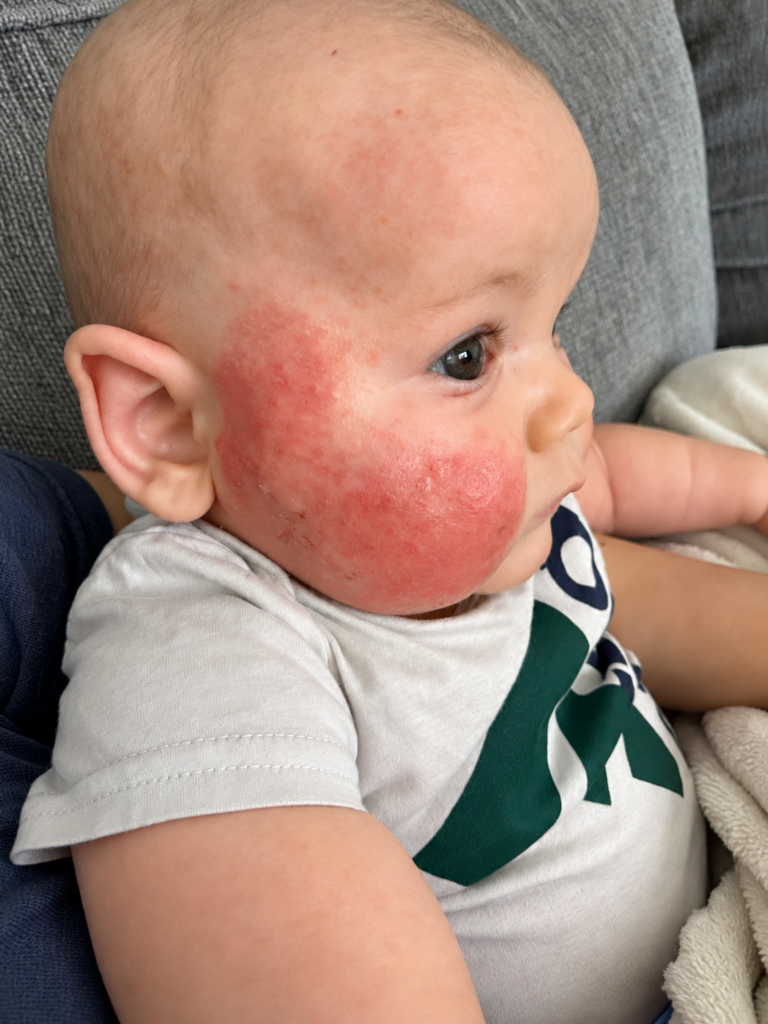
I had already changed so many things in our lifestyle with little to no improvement. We switched everything to fragrance-free. We filtered our water. We tested our 2-year-old home for mold. We bought air purifiers. I personally removed multiple foods from my diet because Ryder was breastfed.
And after all of that, poor Ryder’s skin was still red, cracked, dry, weepy, and so, so itchy.
His sleep—and mine—was seriously taking a hit.
So I took a leap of faith and posted our story in the Facebook group I had joined, looking for suggestions or even just some prayers.
Several people mentioned looking into his gut health.
So back to the books, podcasts, and articles I went, this time taking a deep dive into the relationship between the gut, immune system, and eczema.
Looking Into His Gut Health
The more I read, the more interested I became in the connection between the gut microbiome, immune system, and skin.
Research suggests there is meaningful communication between the gut, immune system, and skin—sometimes referred to as the gut-skin axis. That was enough to make me want to learn more.
It didn’t take long for me to order a gut microbiome test for not only my son, but for myself as well.
Since he was breastfed, I couldn’t help but wonder: Could something about my own health or microbiome be influencing his? Was there another piece of this puzzle we hadn’t found yet?
It took about two weeks from the time the samples were received by the company until we had our results.
The company we used, Tiny Health, was one of the companies I found that offered microbiome testing for infants. They provided an extensive report, a follow-up call to review the results, and recommendations based on what was found.
After implementing some of those recommendations, we started seeing some of the biggest improvements we’d seen in his skin.
His skin was beginning to look like the soft baby skin we had longed for.
First his torso. Then his legs. Then the majority of his arms.
He was nowhere close to being completely clear, but he was miles better than he had been just weeks earlier.
He still had a stubborn open sore on his forearm that he would dig at, and his poor little cheeks were still so up and down. They would go through a cycle of scabbing and crusting, then opening back up and weeping when the scabs came off.
Another Piece of the Puzzle
During my research, I also learned about the relationship between eczema and Staphylococcus aureus (staph) bacteria. People with eczema can have higher levels of S. aureus colonization on their skin, particularly when the skin barrier is damaged, and it can contribute to inflammation and flares.
Eventually, I came across a holistic practitioner based in Germany who had suffered from eczema herself and had made it part of her work to help people explore their eczema triggers and skin health.
She had created what she called a Staph 911 Protocol, which we decided to incorporate into Ryder’s skincare routine.
For us, it made a tremendous difference in both the stubborn area on Ryder’s forearm and his cheeks. Part of the routine involved hypochlorous acid spray followed by moisturizing the skin with an oil, such as jojoba oil.
Where We Are Today
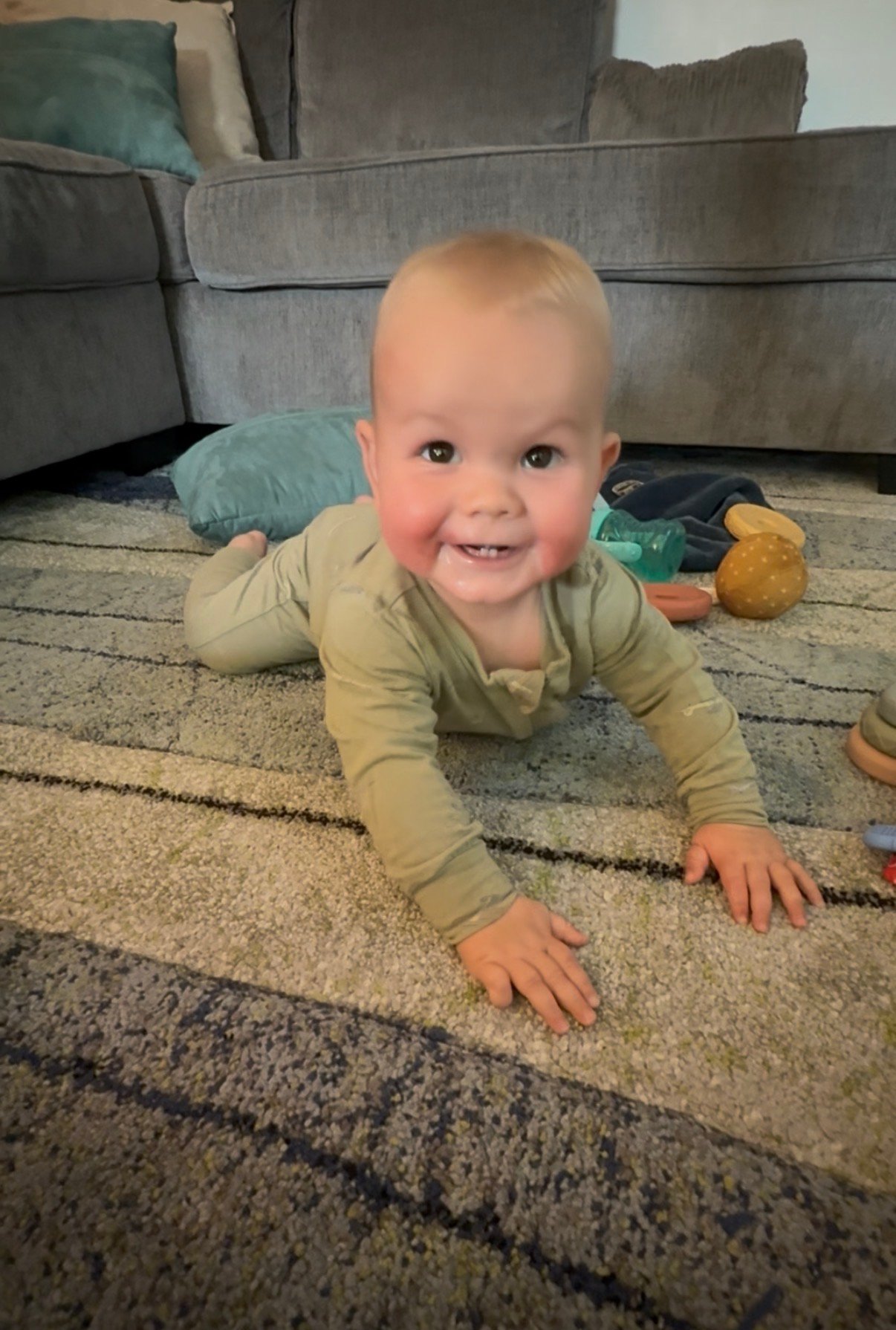
Ryder is now 9 months old, and while his eczema is still not completely resolved, his skin is astronomically better than it was even a month ago.
And, most importantly, he seems so much more comfortable.
We’re still working with his healthcare providers, continuing to learn about his individual triggers, and waiting on follow-up testing. There may still be other pieces to his story that we haven’t figured out yet.
We’re also not naive to the possibility that environmental factors—including our senior dog, Benny—could play a role for him.
Our journey isn’t over.
I’m not writing this because we’ve discovered a magical eczema cure. We haven’t.
I’m writing it because I remember what it felt like to be awake in the middle of the night with an itchy, uncomfortable baby, desperately searching the internet for something—anything—that might help.
If you or someone you love is dealing with eczema, know that you aren’t alone. Ask questions. Advocate for yourself and your family. Work with medical professionals you trust, and don’t be afraid to keep learning.
Every person’s eczema story is different, and Ryder’s story is still being written.
But for the first time in a long time, we finally feel like we’re moving in the right direction.
One of the places our journey took us was Tiny Health. If you’re interested in the microbiome testing we used, you can learn more through our link here → https://amzn.to/3Tr6HzX